Overgrown lawn: what to do when it has got away from you
Spring is when this happens. The lawn sits still through a Melbourne winter, then three warm weeks arrive while it rains every weekend, and by the time anyone gets out there the mower will not go through it. This is what that job actually involves, why it costs more than a standard mow, and when it is worth doing yourself.
Prices current as of August 2026. Figures from other businesses are the published ranges from their own 2026 cost guides.
Why a domestic mower stops coping
Not because the motor is too small. It is that long grass arrives at the blade faster than the deck can throw it out, so the clippings pack under the deck instead of leaving it. The mower bogs, the catcher fills in a few metres, and the cut starts tearing the grass rather than slicing it.
There is also a horticultural limit, and it is the reason nobody who does this for a living takes an overgrown lawn down in one pass. Lawn Solutions Australia describes the one third rule: remove no more than a third of the leaf blade in a single mow. Going past that scalps the lawn, cuts into the stem, and leaves it stressed, browned off and patchy while it recovers.
So the choice on a badly overgrown lawn is not between one careful pass and one rough pass. It is between several passes and a damaged lawn.
What actually happens on the day
The first thing is a walk over the whole lawn looking for what is hiding in it. Long grass conceals bricks, star pickets, dog bones, irrigation heads and the hose fitting somebody lost in February, and any one of those will destroy a blade or fire out sideways at speed.
Then the first pass goes on with the deck at its highest setting, which takes the top off and nothing more. On a lawn that has been left for two months this pass alone can fill the catcher four or five times, and most of the time on the job goes into walking to the trailer and back rather than into mowing.
The second pass comes at a lower setting, across the first at an angle, and it is the one that starts to look like a lawn again. Lawn Solutions Australia’s advice for a very tall lawn is to mow high, then come back the same day or the next and lower the height, repeating until it is where you want it. Where the grass is dense enough or the drop is severe enough, a third pass a few days later finishes it.
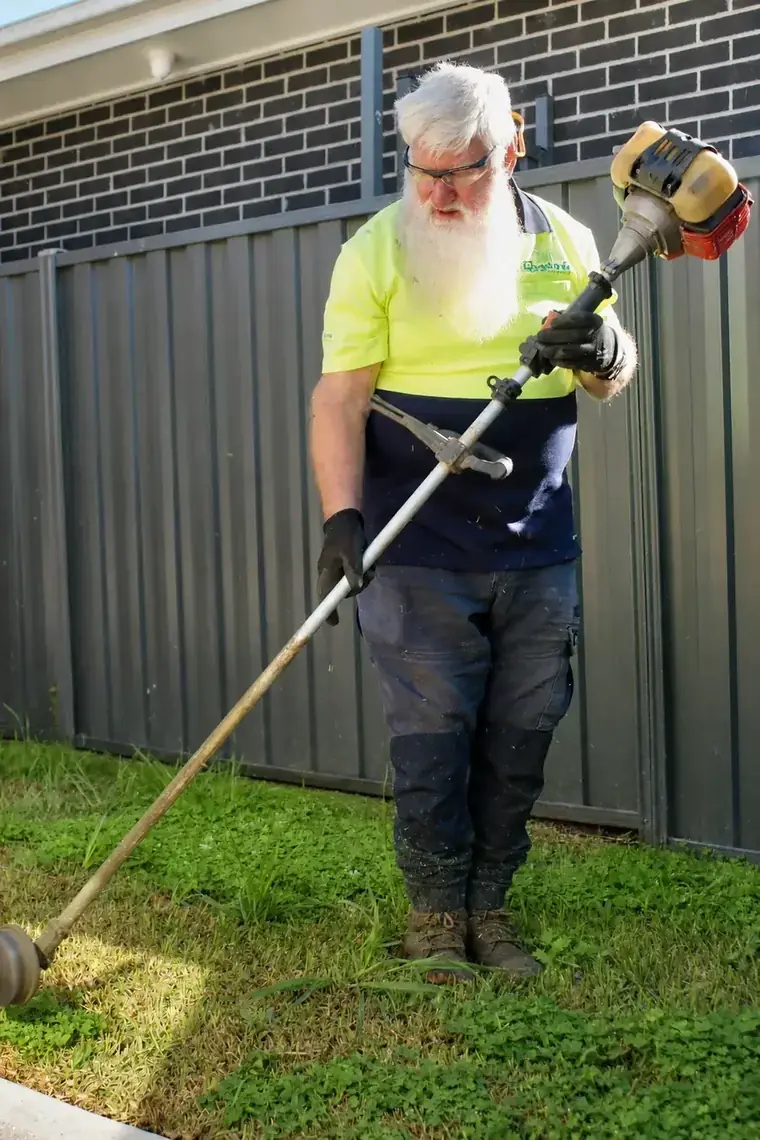
Edges and line trimming come last, because doing them first just buries them. Then the paths and driveway get blown down, and the whole lot goes on the trailer.
The volume is the cost, not the lawn
A lawn cut every fortnight produces clippings that fit in a green lid bin. The same lawn cut after two months of spring growth produces several times that, because the grass is longer and there is more of it, and none of it compresses the way people expect.
In Wyndham the green lid bin is collected fortnightly, on the opposite week to recycling. One overgrown mow will fill it and leave a pile over, and that pile then waits a fortnight or goes on a trailer. That is the actual difference between a $95 mow and a $150 one, and it is why the price is driven by the volume rather than by the square metres.
What it costs against a standard mow
One Melbourne 2026 cost guide puts overgrown rescue cuts as starting at $145, against the $40 to $100 that Melbourne guides put on a standard suburban visit. James charges $95 for a one-off mow on a maintained lawn and from $150 on an overgrown one, so the gap is much the same either way.
Past a certain point it stops being a mowing job at all. If the grass has gone to seed, the beds have disappeared and there is woody growth through the middle of it, the job is a clean-up rather than a mow, and the garden clean-up cost guide is the page with the right figures on it.
When to do it yourself, and when not to
If the grass is dry, the lawn is a normal estate block, and you have two spare afternoons a few days apart, do it yourself. Raise the deck to its highest setting, take a third off, let it stand, then come back and lower it. The work is slow rather than difficult, and the lawn will be better for the patience.
- Do it yourself when the grass is dry, you have a catcher and somewhere for the clippings to go, and no deadline.
- Get help when the grass is wet, because wet long grass packs the deck solid and no amount of patience fixes that.
- Get help when there is a date attached, such as an inspection or a photography day, since the multi pass approach needs days between passes.
- Get help when the disposal is the blocker rather than the mowing, which is the usual reason people ring.
How to stop it happening again
Cut on a fixed interval through the growing season rather than cutting when the lawn looks long. A fortnightly cut through spring keeps every mow inside the one third rule, which means one pass instead of three, a bin that closes, and no rescue job in November.
The lawn that needs rescuing is almost always the one that gets cut when somebody gets around to it. Through a Melbourne spring, getting around to it is roughly three weeks behind where the grass is.
How James prices an overgrown lawn
A one-off mow on an overgrown lawn is from $150, against $95 for a maintained one, and the difference covers the extra passes and the heavier load going to the tip. Fortnightly plans start at $160 a month, which is the version where this never comes up. Every figure is on the plans and pricing page, with no GST.
He is the wrong person to ring if you need it done this afternoon and the grass is soaked. The multi pass approach needs dry grass and, for a bad one, a gap of a day or two between passes. Anyone promising to fix a knee high wet lawn in one visit is either scalping it or leaving the clippings on it.
If James is on a mower when you ring, leave a message. He calls back the same day.